
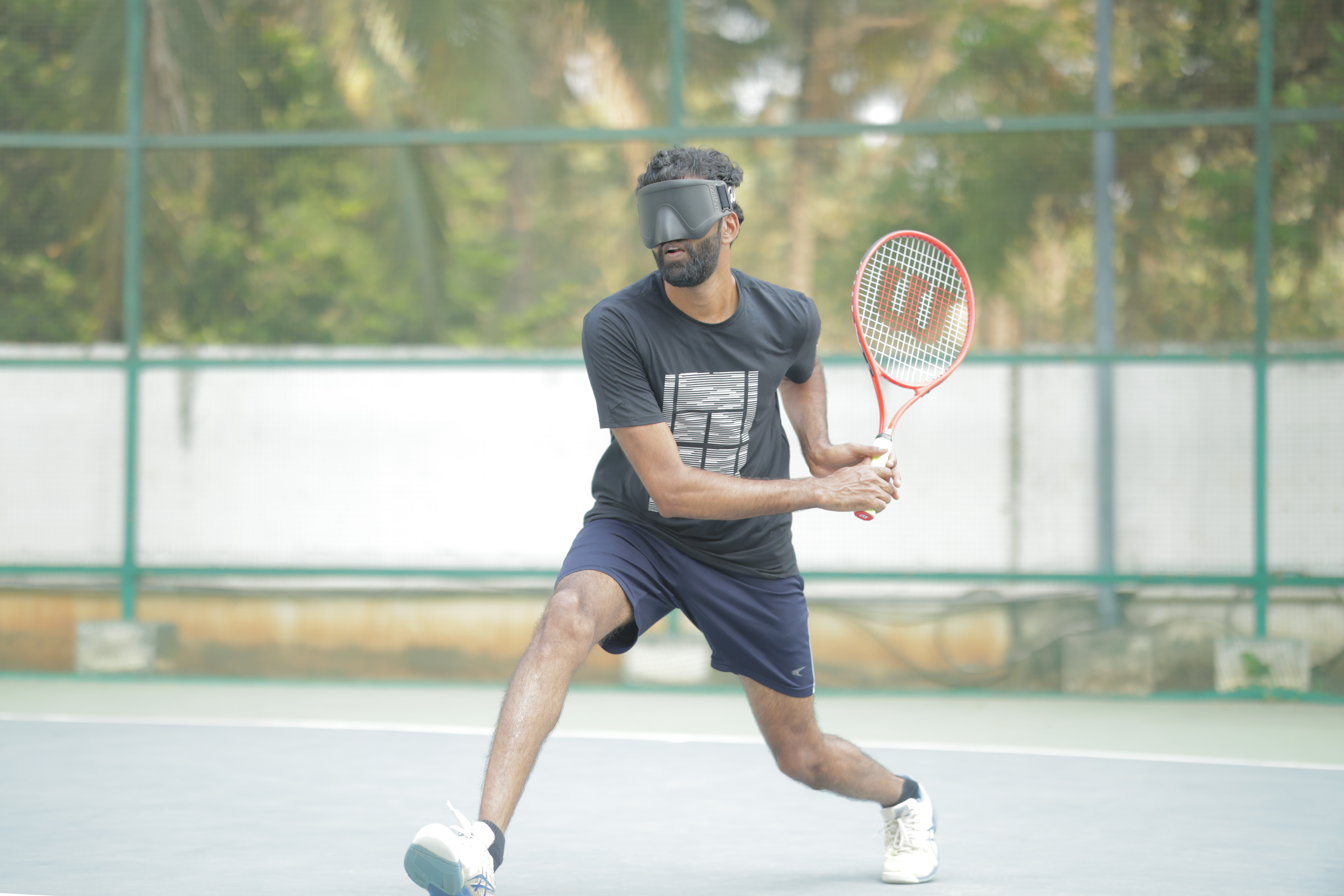
Blind tennis came into my life by coincidence. I remain in it today with a purpose.
For most of my childhood, tennis was a distant sport — something I knew existed, but never something I imagined I would play. I grew up in Wayanad, Kerala, and I cannot remember seeing a tennis court anywhere near my village. Even across the district, tennis was hardly part of everyday sporting culture. Like many children growing up in an Indian village, the sport I knew was cricket. Roads, courtyards and open spaces could become a cricket ground, and I loved being part of it. Sport gave me energy from a very young age.
But cricket was also connected to one of the most difficult turning points of my childhood. When I was nine years old, a cricket practice session changed my life. While I was practising, a cricket ball struck my left eye. I already had limited vision, and the injury resulted in the permanent loss of the remaining vision in that eye. I continued to have partial vision in my right eye for several more years, but glaucoma gradually affected that eye as well. By the time I was in the 11th standard, I had lost my remaining functional vision.
Understandably, my parents became increasingly worried about sport. They had already seen what an injury could do, and they were also trying to understand what my future would look like without sight. Education therefore became the priority. But my interest in sport never completely disappeared — a sporting injury was part of the reason I moved away from sport as a child, while another sport would eventually become one of the strongest purposes in my adult life.
Trying to Find My Way Back to Sport
Around my school years, another blind friend introduced me to blind cricket. I was excited by the possibility of returning to a game I had loved as a child, and I played in a few district-level matches. But I struggled to build the same connection with it — the game was different from the cricket I had grown up playing. I could participate, but emotionally I never quite found my place in it. Gradually, cricket moved away from the centre of my life, and for several years after that, sport was something I loved from a distance.
Then Mumbai changed everything. I had moved to the city for work when I came across a blind tennis training camp organised for players with visual impairments. Until that day, I had never spent time around tennis players or seriously imagined holding a tennis racquet myself. I went to the camp largely out of curiosity. And then I heard the ball.
A blind tennis ball is designed to make sound so that a player can locate and track it. What fascinated me immediately was that the sound was not limited to the ball rolling along the ground — I could hear and follow the ball as it travelled through the air. Suddenly, there was a ball somewhere in three-dimensional space. I had to listen, predict its direction, understand its speed, position my body, time the swing and connect the racquet with it. It was difficult. That was exactly why I loved it.
Blind tennis did not feel like a simplified version of a sport. It felt technically and mentally demanding. Every rally presented a problem that had to be solved in fractions of a second.
My coach, Prem Roy George, often tells me that tennis is fundamentally a mind game. The longer I play, the more I understand what he means. The sound of that first tennis ball in Mumbai opened a door I had never expected to find.
2019 – February 2020
From a First Camp to a National Championship
My involvement became more serious after I moved to Bengaluru to pursue my master's degree at the International Institute of Information Technology Bangalore (opens in a new tab). Continuing blind tennis was not easy — the sport was still extremely new in India, specialised sound balls were difficult to obtain, and finding appropriate opportunities to practise was a challenge. IIIT Bangalore became an important part of that journey: the institute supported my training, provided access to its tennis facilities, and even procured specialised blind tennis balls so that I could continue practising.
In February 2020, I travelled to Patiala, Punjab, for the national blind tennis championship. It was already an adventure before I stepped onto the court — the climate, food, language and surroundings were all different from what I had grown up with in Kerala or Bangalore. After two days of matches, I became the national champion in the fully blind category, defeating 11 participants and qualifying for an international championship scheduled to take place in Italy later that year.
Winning that national championship changed something inside me. Until then, tennis had been an exciting discovery. Patiala made me realise that perhaps I could go much further.
2020 – 2022
The International Dream—and a Long Wait
Italy was supposed to be my first international championship in 2020. Then COVID-19 arrived. The championship was cancelled, international travel stopped, training environments disappeared, and — like athletes around the world — I had no idea when competition would return. For me there was an additional problem: back home in Wayanad, there was no tennis court where I could regularly practise.
So I improvised. At one stage, I practised on a concrete area near my house, using whatever infrastructure was available and playing with local children. It was far from an international training environment, but it kept my relationship with the sport alive. I had already waited years to discover tennis. I was not ready to let the absence of a conventional court end the journey.
The international opportunity finally arrived in 2023.
August 2023 · United Kingdom
Birmingham 2023: My First International Medal for India
In August 2023, I travelled to the United Kingdom to compete in blind tennis at the IBSA World Games (opens in a new tab) in Birmingham — my first international competition, funded by BGSW, where I was employed at that point. I was no longer simply trying to prove something to myself. I was representing India.
- Result Finished the championship with a bronze medal — my first international medal, and a historic first blind-tennis medal for India.
Standing on an international podium representing India was difficult to describe. For someone who had once grown up in a place where I had hardly encountered a tennis court, I was suddenly competing against players from countries where blind tennis had developed over many years. The medal gave me confidence. But sport has a way of reminding you that progress is rarely a straight line.
Late 2023 – 2025
When the Body Forced Me to Stop
After the 2023 championship, I developed a serious physical injury. Radiating pain eventually made normal movement difficult, and tennis had to stop completely — there were moments when I was largely confined to bed. Surgery was discussed as a possibility, but under the treatment of Dr. Jisha, I followed a long non-surgical recovery process.
For an athlete, recovery can be psychologically harder than competition. You watch the months pass. You know other athletes are training. Championships continue without you. Your body remembers what it could once do, while your present reality tells you to wait.
During this period, I missed another international competition in Poland. It took close to a year before I could properly rebuild myself, and when I eventually returned to the court, I was not simply continuing from where I had stopped — in many ways, I had to start again.
An important change came in 2025, when I began working closely with Prem Roy George, a full-time tennis coach and former state-level tennis champion. Until then, much of my blind tennis journey had involved figuring things out as opportunities appeared — finding courts, arranging sound balls, locating people to practise with. With Prem, the approach became more systematic: movement, positioning, stroke production, consistency, match strategy, fitness and the mental side of competition. He had never previously coached blind tennis, and had to learn how I perceived the court without sight and how auditory information replaced visual tracking. Instead of treating that as a limitation, he approached it as a coaching problem to solve — and his commitment transformed my preparation.
2025 · France
2025: Another Cancellation—and Then France
Just as I was rebuilding my competitive career, another setback arrived: an international blind tennis event planned in India in 2025 was cancelled close to the scheduled date, and — like several players who had already made arrangements — I suffered a significant financial loss. After injury, rehabilitation and years of interrupted opportunities, another cancellation was difficult to accept.
Then I heard about an international competition in France in November 2025. I decided to go without any sponsors. That decision became another turning point in my career. At the IBTA Burgundy Grand Prix in France, I progressed through the championship and reached the final, returning to India with the silver medal.
- Ranking The result also helped take me to World No. 5 in the 2025 IBTA (opens in a new tab) B1 men's rankings.
Bronze in 2023 had shown me that I belonged on the international stage. Silver in 2025 showed me that I could move forward even after being forced away from the sport. For me, the most meaningful moment was again seeing the Indian flag on an international podium — the medal represented more than one tournament. It represented the months when I could not play, the slow return to movement, the uncertainty, and the decision to begin again.
2026 · Bengaluru & Vilnius
Vilnius 2026: The Journey Continues
Something else began changing during this period — my ambition was no longer only about my own matches. In 2026, another important chapter began through my association with Sunil Jain, co-founder of Astha and Deuce Tennis Center in Bengaluru, who has also been actively involved in developing and supporting wheelchair tennis in India. Our conversations grew into a larger collaboration around creating opportunities for blind tennis: together with Prem and others supporting the initiative, we organised a two-day blind tennis workshop and a friendly national-level championship in Bengaluru.
Years earlier, I had walked into a workshop in Mumbai without knowing that the experience would change my life. Now I was part of creating that same first opportunity for someone else — new players could hold a racquet, hear the specialised ball, and discover for themselves what blind tennis feels like. That is where the word purpose began to mean something different to me.
Winning still matters enormously to me — I am an athlete, and I enter a championship because I want to compete at the highest level possible. But I also want the next blind athlete in India to have an easier beginning than I did. They should not have to wonder where to find a court, or struggle to locate a blind tennis ball, or travel hundreds of kilometres simply to meet another player. They should be able to imagine international sport as a realistic pathway rather than an unusual exception.
The next chapter takes me to Vilnius, Lithuania, for the 2026 IBTA World Blind Tennis Championships. IBTA's official programme runs from 23 to 29 August 2026, with classification and official practice preceding the competition — another opportunity to wear the India jersey on the international stage.
Sunil's involvement didn't end with organising the workshop. Through Astha and the wider community around us, he initiated and actively supported a crowdfunding campaign for my participation in the 2026 World Blind Tennis Championships in Vilnius. The campaign is still ongoing and open until 29 August 2026 — we are yet to reach the full target amount, and every bit of support helps.
Support the Vilnius campaignAt the same time, Prem and I have continued training sessions in my residential community every week. The conditions may not always resemble those of a professional tennis academy. The ambition does.
I went there by coincidence. Everything that has happened since has given that coincidence a purpose. And I am still discovering where it can lead.